
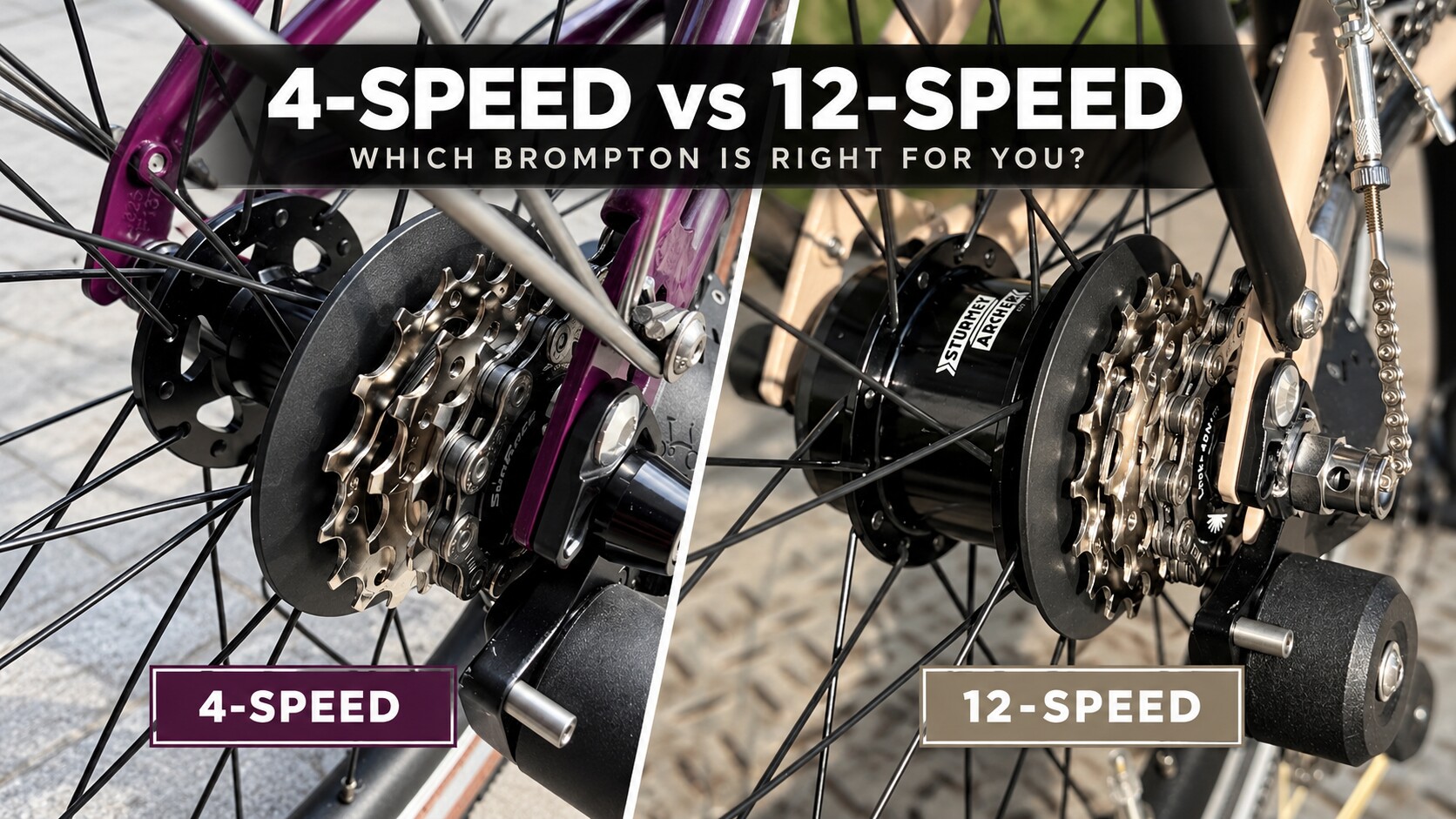
Choosing between a Brompton 4-speed and 12-speed is not simply a question of whether more gears are better. The right choice depends on where you ride, how often you carry the folded bicycle, whether you climb hills, and how much flexibility you want for longer journeys.
For many flatter trips around Singapore, the lighter and simpler 4-speed system is entirely sufficient. The 12-speed becomes more valuable when your rides include steeper slopes, heavier luggage, headwinds, longer distances or unfamiliar routes.
The short answer is: choose the 4-speed if low weight and simplicity matter most; choose the 12-speed if you want the broadest range and the least limitation on where you can ride.
This guide explains the practical difference from the perspective of everyday Brompton use in Singapore.
Brompton 4-speed vs 12-speed at a glance
| Comparison | Brompton 4-speed | Brompton 12-speed |
|---|---|---|
| Gear range | 163% | 402% |
| System | Four external derailleur gears | Four derailleur gears combined with a three-speed internal hub |
| Shifters | One trigger shifter | Two shifters: derailleur and hub |
| Character | Light, simple and direct | Versatile, wide-ranging and adaptable |
| Best suited to | Flatter urban rides, shorter commutes and weight-conscious owners | Hills, longer rides, luggage and varied routes |
| Main advantage | Lower weight and fewer components | Much wider choice of comfortable gears |
| Main compromise | More limited on steep climbs and fast open sections | Additional weight and a slightly more involved shifting system |
The exact weight and equipment depend on the Brompton line, handlebar, rack, lighting and other specifications. Always compare complete bicycles in equivalent configurations rather than judging by the number of gears alone.
What does “gear range” mean?
The number of gears tells you how many selectable ratios a bicycle has. Gear range tells you how far the gearing extends from its easiest gear to its hardest gear. For real-world riding, the range is often the more important figure.
The current Brompton 4-speed drivetrain has a 163% range. Its four sprockets—11, 13, 15 and 18 teeth on standard configurations—provide useful steps for city riding while keeping the system compact and light.
The Brompton 12-speed drivetrain has a substantially wider 402% range. It combines the four-speed derailleur system with a three-speed internal hub, producing low gears for climbing, middle ratios for everyday riding and higher gears for faster sections.
This does not mean that a 12-speed is automatically faster. It means you have a better chance of finding a comfortable pedalling rhythm across different gradients, speeds and loads.
When is a Brompton 4-speed enough in Singapore?
Singapore is not completely flat, but many everyday cycling routes are gentle enough for a 4-speed Brompton. It can work very well for:
- Short and medium-distance commuting
- Park connectors and flatter urban routes
- Breakfast, café and neighbourhood rides
- Rail Corridor journeys with a relaxed pace
- Cycling to an MRT station and continuing by train
- Riders who travel light and rarely carry large front luggage
- Owners who strongly value a lighter bicycle
The 4-speed has a clean, direct feel. One trigger shifter controls the four derailleur gears, so it is quick to understand and easy to operate. Riders who use their Brompton mainly as a compact urban mobility tool may never feel that they are missing anything.
Its lower weight is particularly relevant if you regularly carry the bicycle upstairs, lift it into a vehicle or move through stations where lifts are inconvenient. Once folded, even a modest weight difference can become noticeable when repeated every day.
Where does the 12-speed help?
The 12-speed makes the strongest case when your journeys go beyond flatter point-to-point transport. Its wider range is useful for:
- Mount Faber, Henderson Road, Kent Ridge and other steeper areas
- Longer weekend and community rides
- Heavy front luggage or touring loads
- Headwinds on exposed stretches
- Riders who want smaller choices between comfortable pedalling efforts
- Travel to places where the terrain is unfamiliar
- Owners who want one Brompton for the widest variety of uses
The easiest gears reduce the effort needed to keep the pedals turning on a climb. The higher end of the range is useful when the road opens up or slopes down. Between those extremes, the additional ratios make it easier to avoid feeling that one gear is too easy while the next is too hard.
For a rider who wants to explore Singapore freely without planning routes around hills, the 12-speed is the more reassuring choice.
How does the Brompton 12-speed system work?
The system combines two types of gearing. The derailleur moves the chain across four rear sprockets, while the three-speed hub changes the broader range. Together, they provide 12 selectable combinations.
A practical way to think about it is:
- Use the hub to choose a broad low, middle or high range.
- Use the four derailleur gears to fine-tune your pedalling within that range.
The external derailleur shifts while you are pedalling lightly because the chain must move between sprockets. The internal hub can shift while the bicycle is stationary, which is useful if you stop at a traffic light in a high gear and want an easier gear before moving off.
There is a short learning period because the 12-speed has two controls, but most owners adapt quickly. You do not need to memorise every possible combination before riding. Start in the middle hub range, use the derailleur normally, and change the hub range when you need gears that are meaningfully easier or harder.
Is the 4-speed easier to maintain?
The 4-speed has fewer drivetrain components and no internal gear hub, so it is mechanically simpler. That simplicity appeals to riders who want a lightweight, straightforward urban bicycle.
The 12-speed has an additional hub shifter, cable and internal gearing system. It therefore requires correct adjustment and adds some weight. However, it is an original Brompton system designed as an integrated package, and the internal hub keeps its gear mechanism protected inside the rear wheel.
Both systems still need normal preventive care: a clean and lubricated chain, correctly adjusted gears, sound cables, suitable tyre pressure and periodic servicing. More gears should not be treated as a substitute for proper setup.
808 Cycles supports original Brompton gearing configurations. We recommend choosing the factory system that suits your needs instead of buying a bicycle on the assumption that an aftermarket conversion will solve the decision later.
Does the 12-speed change the folded size?
No meaningful difference in folded footprint should drive this choice. Both systems are engineered to fit within Brompton’s compact fold.
The practical portability difference is weight. A 4-speed configuration is generally lighter because it does not carry the three-speed internal hub and its related controls. The precise difference varies between C Line, P Line and T Line configurations, as well as racks, handlebars, saddles, lighting and accessories.
If carrying matters to you, fold and lift the actual bicycles. A specification sheet cannot tell you whether the difference feels worthwhile on your staircase or during your MRT journey.
Which gearing is better for commuting?
For a flat or gently rolling commute, the 4-speed can be the better tool. It is lighter, simple to shift and provides enough range for many city journeys.
The 12-speed is preferable when your commute includes repeated slopes, longer distances, strong headwinds or a heavily loaded bag. It also provides more flexibility if you sometimes extend your commute into a leisure ride.
Think about the most demanding part of your regular journey—not only the easiest section. If one steep climb makes you avoid cycling altogether, the wider gearing may help you use the bicycle more consistently. If you rarely encounter that situation, carrying the lighter 4-speed every day may be the more valuable benefit.
For more mixed-transport advice, read our guide to bringing a Brompton on Singapore’s MRT.
Which gearing is better for leisure rides and travel?
A 4-speed is enjoyable for relaxed city exploration, café rides and flatter routes. Its lighter weight can also be attractive when the bicycle must be lifted frequently during a journey.
A 12-speed is the safer all-round choice for longer rides and overseas travel because you may not know the terrain in advance. Luggage, fatigue and heat can make a gradient feel harder late in a ride, even if it looked manageable on a map.
If your Brompton will be your only bicycle and you expect your riding ambitions to grow, the 12-speed provides more room to explore. If you already know that your use will remain compact, urban and relatively flat, the 4-speed may be all you need.
Should a first-time buyer choose 4-speed or 12-speed?
Choose the 4-speed if:
- Your usual routes are mostly flat.
- You prioritise the lowest practical carrying weight.
- You prefer one simple shifter.
- Your rides are generally short to medium in distance.
- You travel light and do not expect frequent steep climbs.
Choose the 12-speed if:
- You want the widest possible range for Singapore’s varied routes.
- You regularly climb hills or carry luggage.
- You take longer rides or travel with your Brompton.
- You prefer more choices for maintaining a comfortable cadence.
- You would rather accept additional weight than risk feeling under-geared.
Neither is universally better. The best system is the one that removes the biggest barrier to using your Brompton. For one owner, that barrier is carrying weight. For another, it is a steep climb on the way home.
Does the bicycle line matter too?
Yes. Gearing is only one part of the decision. Frame materials, overall weight, fork design, component specification and price also differ between the C Line, P Line and T Line.
Read our Brompton C Line versus P Line comparison and our guide to the Brompton P Line versus T Line before comparing specific bicycles.
A lighter line with 12-speed gearing can still be easier to carry than a heavier line with fewer gears. Compare complete bicycles rather than assuming the drivetrain alone determines portability.
Frequently asked questions
Is a Brompton 4-speed enough for Singapore?
Yes, for many riders. It suits flatter commutes, park connectors, mixed MRT journeys and relaxed urban riding. The decision changes if your regular routes include steep climbs, heavy luggage or longer distances.
Can a 4-speed Brompton climb Mount Faber?
A fit rider may manage it, but the limited low-end range demands more effort. A 12-speed gives you substantially easier gearing and is the more comfortable choice for repeated or steeper climbs.
Is a Brompton 12-speed difficult to use?
It uses separate controls for the four-speed derailleur and three-speed hub, so it takes slightly longer to learn than the 4-speed. Most riders adapt quickly by using the hub for broad ranges and the derailleur for smaller adjustments.
Does a 12-speed Brompton fold larger?
No meaningful folded-size difference should affect the decision. The 12-speed system is designed to remain within Brompton’s compact folded package, although it adds weight compared with an equivalent 4-speed configuration.
Is a 12-speed Brompton faster than a 4-speed?
Not automatically. It has a wider range, which can help you pedal comfortably on more terrain. Actual speed depends more on fitness, riding position, tyres, conditions and luggage.
Can I convert a Brompton 4-speed to 12-speed later?
Changing between the systems involves more than adding sprockets; the rear wheel, hub controls, cables and other parts differ. Do not treat it as a simple future upgrade. Choosing the appropriate original configuration at purchase is usually the cleaner approach.
Which gearing should I choose if I am still unsure?
Test both on the same route, including a slope, and lift both while folded. Choose the 4-speed if its range feels sufficient and you value its lower weight. Choose the 12-speed if the easier gears make you more confident about riding further and more often.
Compare Brompton gearing at 808 Cycles
808 Cycles has been a Brompton Authorised Dealer in Singapore since 2016. We ride Bromptons ourselves and can help you compare original 4-speed and 12-speed configurations based on your routes, fitness, luggage and carrying requirements.
Browse our current Brompton C Line bicycles, Brompton P Line bicycles, Brompton T Line bicycles or all Brompton folding bicycles available in Singapore.
Still deciding? WhatsApp 808 Cycles to arrange a showroom visit and test ride. Tell us where you normally ride and whether you need to carry the folded bicycle—we will help you compare the options honestly.
About the author: Bob Lee is the founder of 808 Cycles, a Brompton Authorised Dealer in Singapore since 2016. He rides a Brompton regularly and helps customers choose, set up and maintain their bicycles for everyday use in Singapore.